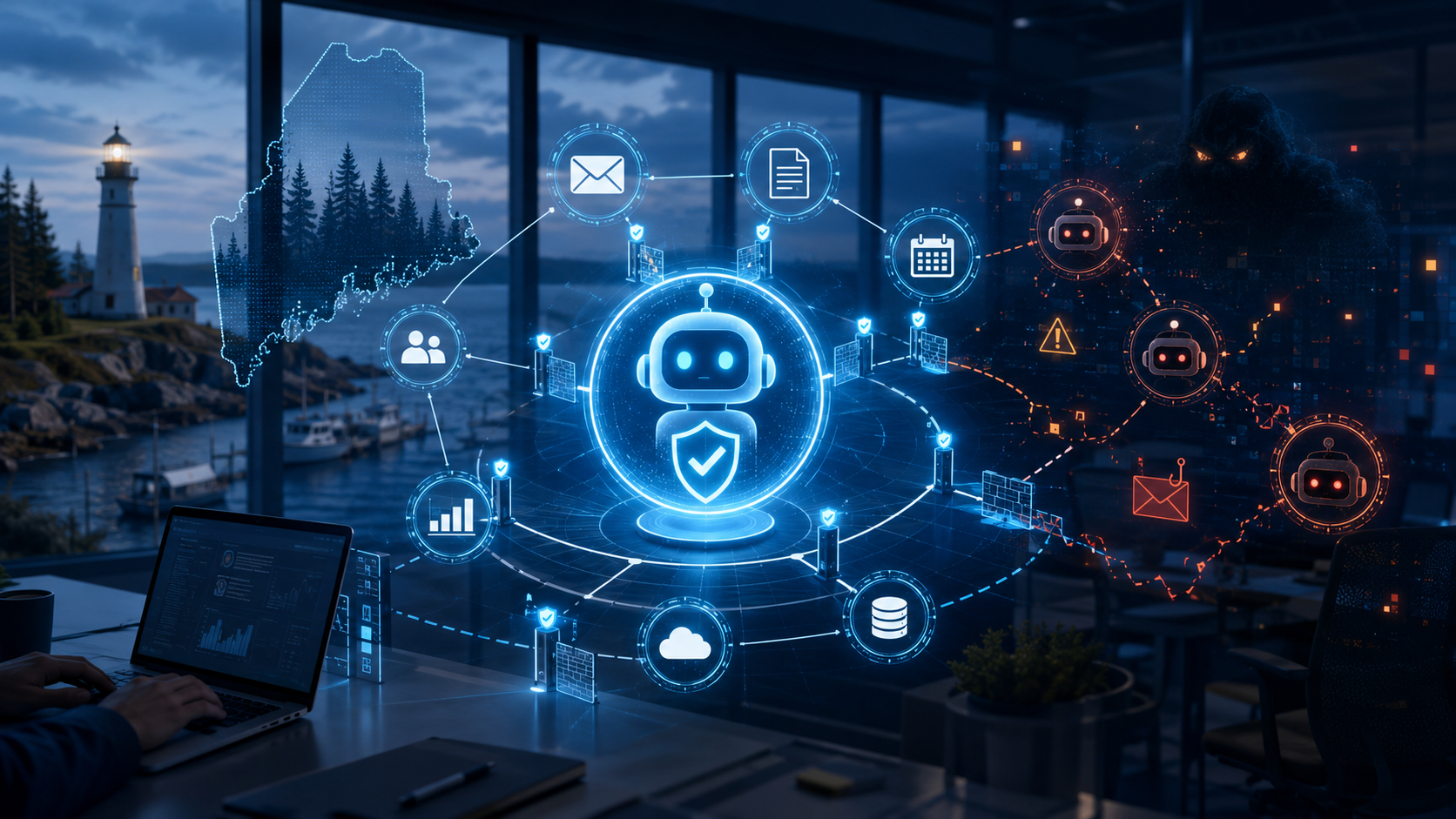
Artificial intelligence is no longer just a tool for writing emails, summarizing documents, or brainstorming ideas. A new stage of AI is beginning to enter the workplace: AI agents.
Unlike a basic chatbot, an AI agent can take a goal and complete multiple steps to reach that goal. It may search documents, open files, connect to business software, draft emails, update records, analyze spreadsheets, or trigger actions across different systems. For Maine businesses, nonprofits, municipalities, schools, healthcare organizations, real estate companies, and professional service firms, this creates a major opportunity.
It also creates a new kind of risk.
As AI tools become more capable, the question is no longer only, "Can this tool help us save time?" The better question is, "Can we use this tool safely, responsibly, and with the right controls?"
That is why the concept of Zero Trust is becoming more important for organizations exploring AI agents.
What Is Zero Trust?
Zero Trust is a cybersecurity approach built around a simple idea: do not automatically trust anything. Verify every request, limit access, and assume that mistakes or compromises can happen.
Traditional security often worked like a building with a locked front door. Once someone was inside the network, they were often trusted more than they should have been. But modern threats do not work that way. Attackers may already have stolen credentials. Employees may accidentally click unsafe links. Vendors may have weak systems. And now, AI agents may be connected to business tools that can take action quickly.
Zero Trust changes the mindset.
Instead of asking, "Is this request coming from inside our organization?" it asks, "Should this user, tool, or agent be allowed to do this specific action right now?"
That difference matters.
Why AI Agents Need Stronger Security
A normal software program usually follows a fixed path. It does what it was coded to do. AI agents are different. They interpret instructions, choose steps, use tools, and sometimes make decisions within the permissions they are given.
That flexibility is useful, but it also means an agent can be tricked, misused, or over-permissioned.
For example, imagine a Maine property management company uses an AI agent to help answer tenant emails and summarize maintenance requests. That agent may need access to email, documents, tenant records, and vendor information. If the agent is given too much access, a simple mistake or malicious instruction could expose private information or cause the agent to take an action it should not take.
Or imagine a nonprofit using an AI agent to help manage grant documents, donor lists, and outreach emails. The agent may be helpful, but it should not have unlimited access to financial records, employee files, or sensitive client data.
The same applies to municipalities. A town office using AI to help with citizen requests, public documents, meeting summaries, or internal workflows must be careful about privacy, records management, and public trust.
AI agents should not be treated like harmless assistants. If they can access systems, read data, or take action, they need security boundaries.
The Main Risks Maine Organizations Should Understand
One major risk is prompt injection. This happens when someone gives an AI system hidden or malicious instructions. Sometimes the instruction is direct, such as telling the AI to ignore its rules. Other times it is indirect, hidden inside a webpage, email, file, or document that the AI reads.
That is especially important for AI agents because agents often process outside information. If an agent reads a malicious email or webpage and treats hidden instructions as real commands, it may act in ways the user never intended.
Another risk is tool misuse. An AI agent may have access to legitimate tools, such as email, calendars, spreadsheets, customer records, or file storage. The danger is not always that the tool itself is hacked. The danger may be that the agent uses normal tools in the wrong sequence.
For example, one tool may let the agent read customer information. Another tool may let it send emails. Separately, both tools may be allowed. But together, they could create a path for private data to leave the organization.
A third risk is memory and context poisoning. Some AI systems remember information across sessions. That can make them more helpful, but it can also create risk if bad information or unsafe instructions get stored and influence future behavior.
There are also supply chain risks. AI agents often rely on models, plugins, integrations, open-source tools, APIs, and frameworks. If one part of that chain is unsafe, the whole system may be affected.
What Least Privilege Means for AI Agents
One of the most practical ideas from Zero Trust is least privilege. This means every person, system, and AI agent should only have the minimum access needed to do its job.
For AI agents, we can take this one step further. The idea is not only least privilege, but also least agency.
Least agency means limiting what the agent can do, how often it can do it, which tools it can use, and under what conditions.
A scheduling agent may need access to a calendar, but it may not need access to payroll files.
An email drafting agent may need to draft messages, but it may not need permission to send without human approval.
A document summarizing agent may need read-only access, but it may not need permission to delete, move, or share files.
A customer service agent may need access to FAQs and service history, but it may not need access to full financial records.
This is the kind of practical thinking Maine organizations should apply before connecting AI agents to real business systems.
Why This Matters for Maine
Maine has many organizations that operate with small teams and limited technical staff. That includes small businesses, nonprofits, local governments, schools, trades, healthcare providers, property managers, and community organizations.
These organizations often do not have large cybersecurity departments. At the same time, they handle sensitive information: customer records, financial documents, employee data, student information, donor lists, medical information, housing records, legal documents, and internal communications.
AI can help these organizations save time and improve service. But if AI is adopted without planning, it can also introduce avoidable risks.
The goal is not to scare organizations away from AI. The goal is to help them adopt AI in a safer way.
Maine organizations do not need to start with a complicated enterprise security program. But they should start with strong basics:
- Give AI tools limited access.
- Use human approval for important actions.
- Keep logs of what AI tools do.
- Avoid connecting AI agents to sensitive systems without a clear plan.
- Review vendors carefully.
- Train staff on safe AI use.
- Create policies for what AI can and cannot be used for.
- Have a rollback plan if something goes wrong.
These steps are practical, affordable, and realistic for many Maine organizations.
A Simple Example
Let's say a Maine business wants to use an AI agent to help with customer inquiries.
A risky setup would be giving the agent full access to email, customer records, billing systems, and file storage, then allowing it to respond automatically to customers.
A safer setup would look different.
The agent could be limited to reading only approved customer support documents and recent inquiry emails. It could draft responses, but a human would approve them before sending. It would not have access to billing details unless necessary. It would not be allowed to delete emails, export customer lists, or send attachments without approval. All actions would be logged. If the agent behaves strangely, its access could be turned off quickly.
That is Zero Trust thinking in plain English.
AI Readiness Is Not Just About Tools
Many organizations think AI readiness means choosing the right software. That is only one part of the picture.
Real AI readiness includes people, process, policy, data, security, and governance.
Before adopting AI agents, organizations should ask:
- What data will the agent access?
- What actions can it take?
- Who approves those actions?
- What happens if the agent makes a mistake?
- Can we see a log of what happened?
- Can we turn it off quickly?
- Are employees trained on safe AI use?
- Do we have a written policy?
These questions are especially important for regulated or sensitive environments such as healthcare, finance, education, housing, legal services, and government.
A Resource for Organizations Exploring AI Agents
For organizations that want to understand this topic more deeply, AI Impact Maine has added a new resource to the resource library: Zero Trust for AI Agents.
This guide explains how Zero Trust principles can be applied to autonomous AI agents. It covers risks such as prompt injection, tool misuse, identity and privilege abuse, supply chain threats, memory poisoning, logging, monitoring, input/output controls, recovery planning, and AI governance.
It is a strong resource for leaders, IT teams, compliance staff, and anyone responsible for evaluating how AI agents may be used inside an organization.
Download the Zero Trust for AI Agents resource.
Final Thoughts
AI agents will likely become part of the modern workplace. They will help organizations move faster, reduce repetitive work, improve service, and support staff. But the more access these agents receive, the more important security becomes.
For Maine organizations, the best path is not to avoid AI. The best path is to adopt AI with clear boundaries.
Start small.
Limit access.
Keep humans involved in high-risk decisions.
Train staff.
Document policies.
Review vendors.
Log activity.
Plan for mistakes before they happen.
AI can be a powerful tool for Maine's businesses, nonprofits, municipalities, and community organizations. But trust should be earned, not assumed.
That is the heart of Zero Trust for AI agents.
Sources & Further Reading: