Executive Summary
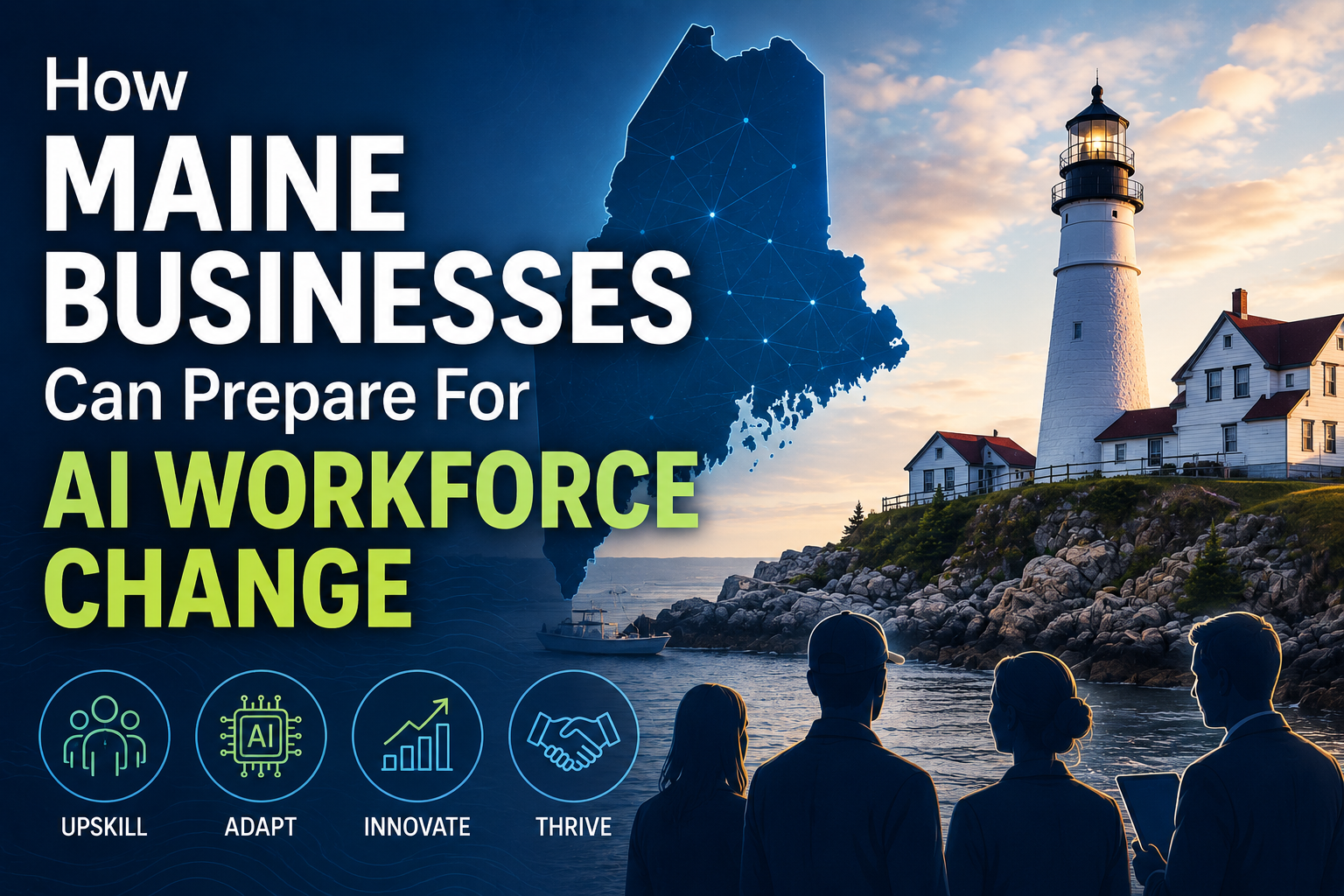
Maine businesses can prepare for AI workforce change by training staff, auditing workflows, setting governance rules, and building practical adoption habits.
AI workforce change is not a single event. It is a gradual shift in how documents are drafted, how calls are handled, how meetings are summarized, how policies are reviewed, how customers are followed up with, and how managers evaluate work. The organizations that benefit will not be the ones with the fanciest tools. They will be the ones that train people and redesign practical workflows.
Microsoft's 2025 Work Trend Index describes human-agent collaboration and new expectations for workers who can delegate to and supervise AI systems (Microsoft Work Trend Index). McKinsey's 2025 research shows that adoption alone does not guarantee scaled value; organizations need workflow redesign, training, leadership, and measurement (McKinsey State of AI 2025).
- Start with workflow audits, not tool shopping.
- Train staff on prompting, verification, privacy, and responsible use.
- Create a simple AI policy before usage spreads informally.
- Measure practical improvements in real work.
- Treat AI as a change-management project, not just software.
The workforce change is task-level
Goldman Sachs' generative AI research focuses on task exposure and productivity potential (Goldman Sachs labor market report). That distinction matters. A bookkeeper, project manager, grant writer, office administrator, service dispatcher, or municipal clerk does many tasks. AI may help with some of them while making human judgment more important in others.
Maine employers should therefore avoid sweeping claims. Instead, list tasks. Which are repetitive? Which require confidentiality? Which are public-facing? Which are regulated? Which are frustrating employees? Which create customer delays? That map becomes the adoption plan.
What this means for Maine businesses
For Maine employers, the practical question is not whether a national AI trend sounds impressive. The question is whether it changes a real workflow in a small business, town office, school, nonprofit, healthcare practice, construction firm, law office, hospitality group, or professional services team. Maine organizations often run lean. A single administrative bottleneck, missed follow-up, slow intake process, or inconsistent document workflow can matter more than a headline about frontier models. That is why AI adoption here should start with work mapping, staff training, privacy rules, and measurable use cases rather than broad experimentation.
A manufacturer might start with maintenance documentation and shift notes. A nonprofit might start with grant drafts and donor communications. A municipality might start with meeting summaries and policy research. A hospitality group might start with customer-response templates and seasonal hiring materials. Each use case should include training, rules, and review.
Action steps
- Pick one workflow where better drafting, summarizing, routing, or follow-up would save time without increasing risk.
- Write down what data is allowed, what data is restricted, and who approves new AI tools before staff begin experimenting.
- Train staff on prompting, verification, privacy, and escalation instead of assuming a tool rollout equals adoption.
- Measure results with simple operational metrics: time saved, errors reduced, response speed, customer satisfaction, and staff confidence.
- Review the workflow after 30 days and decide whether to scale, revise, or stop.
Risks and limitations
The biggest mistake is assuming AI adoption is automatic. Employees may be anxious, skeptical, overconfident, or inconsistent. Leaders should create space for practice and questions. They should also be clear that AI is not an excuse to lower standards for accuracy, privacy, or service.
How to evaluate this locally
The safest way to evaluate maine business is to turn the trend into a local workflow question. A Maine organization should ask where the issue touches actual work: intake, scheduling, documentation, customer response, employee training, vendor selection, records management, grant writing, policy review, operations reporting, or leadership decision-making. This keeps the conversation grounded. Instead of asking whether AI is impressive, ask whether it can improve one defined process without weakening privacy, trust, accessibility, or accountability.
That evaluation should include people who understand the work, not only technology decision-makers. Front-desk staff, program managers, municipal clerks, department heads, finance staff, HR leaders, and customer-facing employees often know where work breaks down. They know which forms are confusing, which emails repeat, which reports take too long, which approvals stall, and which customers need a human voice. Their input helps separate useful automation from expensive theater.
What to measure
A practical pilot should measure results before it expands. Useful measures include time saved, number of drafts produced, error rates, customer response time, staff satisfaction, number of escalations, and whether sensitive information stayed inside approved systems. For public-sector or nonprofit settings, add transparency and documentation measures: who reviewed the output, whether sources were retained, and whether final decisions were made by accountable people.
Leaders should also measure friction. If a tool saves one hour of drafting but creates two hours of cleanup, it is not a productivity gain. If staff avoid it because the policy is unclear, the issue is training and governance. If the tool works only for one tech-comfortable employee, the organization has not yet built a repeatable process. The goal is not a flashy demonstration. The goal is a repeatable operating habit.
Governance questions before scaling
- What data can safely be used with this tool, and what data is prohibited?
- Who is accountable for reviewing outputs before they affect customers, residents, employees, or clients?
- What is the human fallback when the tool is wrong, confusing, biased, unavailable, or inappropriate?
- How will staff know whether a vendor changed model behavior, retention rules, or product terms?
- What records need to be preserved for compliance, public accountability, or internal learning?
A 90-day adoption path
In the first 30 days, select one low-risk workflow and document the current process. In days 31 to 60, train a small group of staff, run the workflow with human review, and collect simple before-and-after measures. In days 61 to 90, decide whether to keep, revise, or stop the pilot. If it works, write the process down so another staff member can repeat it. If it does not work, document why. A failed pilot with clear learning is much better than uncontrolled experimentation with no record.
For AI Impact Maine's clients, this kind of operating discipline is usually where value appears. The technology matters, but the durable advantage comes from clearer workflows, better staff confidence, stronger policies, and a habit of evaluating AI against real outcomes. That is how a Maine organization can respond to how maine businesses can prepare for ai workforce change without being swept up by hype or frozen by uncertainty.
Leadership checklist for Maine organizations
Before acting on this trend, leaders should bring the conversation back to mission, customers, employees, and risk. The right question is not whether another organization is using AI aggressively. The right question is whether your organization can use it in a way that improves service and preserves trust. That means naming the owner of the workflow, the reviewer of AI-assisted work, the data that may be used, the data that may not be used, and the point at which a person must step in.
It also means communicating clearly with staff. Employees should know whether AI is being used to support them, evaluate them, replace a task, improve a customer experience, or reduce administrative burden. Ambiguity creates fear. Clear boundaries create participation. In many Maine organizations, the strongest AI ideas will come from the people closest to the work once they understand the rules and have a safe way to experiment.
Finally, leaders should decide what would make the effort worth continuing. If the pilot saves time but reduces quality, it needs revision. If it improves quality but requires too much review, the workflow may need a narrower scope. If it improves both quality and speed, the next question is whether it can be documented, trained, and repeated. That is the difference between a one-off AI experiment and an operational capability.
Sources & Further Reading:
- https://news.microsoft.com/annual-work-trend-index-2025/
- https://www.mckinsey.com/capabilities/quantumblack/our-insights/the-state-of-ai
- https://hai.stanford.edu/ai-index/2025-ai-index-report
- https://www.gspublishing.com/content/research/en/reports/2023/03/27/d64e052b-0f6e-45d7-967b-d7be35fabd16.pdf
- https://www.nist.gov/itl/ai-risk-management-framework