Executive Summary
The reported hydration-agent story is less important as a gadget than as a warning about AI systems that observe people and push real-world behavior.
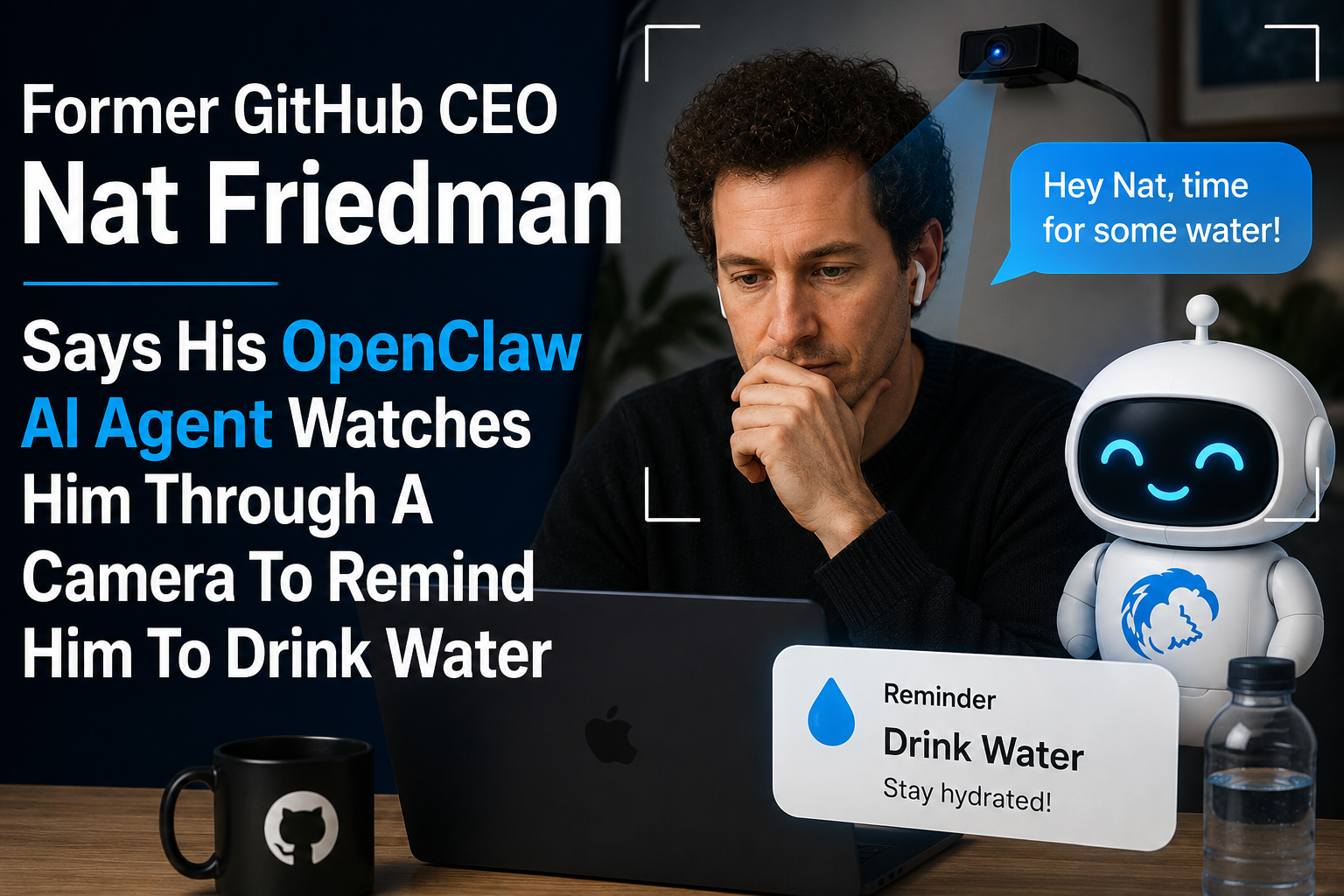
A recent report described an OpenClaw agent associated with former GitHub CEO Nat Friedman that used a camera to verify whether he drank water after the agent nudged him to do so (reported by Blockchain.news). The story is unusual, and organizations should treat it as an anecdote rather than a procurement model. But it is useful because it makes the next AI governance issue concrete: what happens when agents observe the physical world and try to change human behavior?
A hydration reminder sounds harmless. In a workplace, the same pattern could become productivity monitoring, safety compliance checks, attendance verification, sales coaching, or customer-service surveillance. The technical capability is not the whole issue. Consent, proportionality, data retention, employee trust, and access control become central.
- AI agents are beginning to connect digital instructions with physical-world observation.
- Monitoring can be helpful in limited contexts, but it can quickly become intrusive.
- Maine employers should set clear rules before using cameras, sensors, or screen monitoring with AI.
- Use consent, purpose limits, retention limits, and human review.
- Do not let novelty override workplace trust.
Why this story matters
The business lesson is not that every company needs a camera-connected agent. The lesson is that AI systems are moving from generating text to making observations, interpreting context, and prompting action. A system that watches for a water bottle today could watch a workstation tomorrow. It could monitor whether a driver follows a checklist, whether a cashier smiles, whether a remote worker appears attentive, or whether a nurse follows a documentation process.
NIST's AI Risk Management Framework encourages organizations to map context and impacts before deployment (NIST AI RMF). That is especially relevant for monitoring tools because the same capability can have different risk depending on who is monitored, what is captured, how long it is stored, and whether employees can challenge the result.
Maine workplace implications
For Maine employers, the practical question is not whether a national AI trend sounds impressive. The question is whether it changes a real workflow in a small business, town office, school, nonprofit, healthcare practice, construction firm, law office, hospitality group, or professional services team. Maine organizations often run lean. A single administrative bottleneck, missed follow-up, slow intake process, or inconsistent document workflow can matter more than a headline about frontier models. That is why AI adoption here should start with work mapping, staff training, privacy rules, and measurable use cases rather than broad experimentation.
In Maine's smaller workplaces, trust is often a competitive advantage. Employees know each other, customers recognize staff, and reputation travels quickly. Introducing AI monitoring without clear limits can create anxiety even if the technical goal is reasonable. A better approach is to separate helpful reminders from surveillance. For example, an AI tool can remind a project manager about overdue tasks without watching the manager through a camera.
Action steps
- Write a monitoring policy before adopting AI systems that use cameras, microphones, screen capture, location, or keystroke data.
- Require explicit business purpose, consent where appropriate, and minimal data collection.
- Ban secondary use of monitoring data unless employees were told about that use in advance.
- Keep humans responsible for employment, safety, and disciplinary decisions.
- Review state and federal privacy, labor, and sector-specific requirements before deployment.
Risks and limitations
The FTC's broader AI work is a reminder that AI claims and AI-enabled consumer or worker harms can still fall under existing laws (FTC AI guidance). Even when a tool is legal, it may be culturally wrong for a workplace. Leaders should ask whether the tool improves work or merely increases measurement.
How to evaluate this locally
The safest way to evaluate ai agents is to turn the trend into a local workflow question. A Maine organization should ask where the issue touches actual work: intake, scheduling, documentation, customer response, employee training, vendor selection, records management, grant writing, policy review, operations reporting, or leadership decision-making. This keeps the conversation grounded. Instead of asking whether AI is impressive, ask whether it can improve one defined process without weakening privacy, trust, accessibility, or accountability.
That evaluation should include people who understand the work, not only technology decision-makers. Front-desk staff, program managers, municipal clerks, department heads, finance staff, HR leaders, and customer-facing employees often know where work breaks down. They know which forms are confusing, which emails repeat, which reports take too long, which approvals stall, and which customers need a human voice. Their input helps separate useful automation from expensive theater.
What to measure
A practical pilot should measure results before it expands. Useful measures include time saved, number of drafts produced, error rates, customer response time, staff satisfaction, number of escalations, and whether sensitive information stayed inside approved systems. For public-sector or nonprofit settings, add transparency and documentation measures: who reviewed the output, whether sources were retained, and whether final decisions were made by accountable people.
Leaders should also measure friction. If a tool saves one hour of drafting but creates two hours of cleanup, it is not a productivity gain. If staff avoid it because the policy is unclear, the issue is training and governance. If the tool works only for one tech-comfortable employee, the organization has not yet built a repeatable process. The goal is not a flashy demonstration. The goal is a repeatable operating habit.
Governance questions before scaling
- What data can safely be used with this tool, and what data is prohibited?
- Who is accountable for reviewing outputs before they affect customers, residents, employees, or clients?
- What is the human fallback when the tool is wrong, confusing, biased, unavailable, or inappropriate?
- How will staff know whether a vendor changed model behavior, retention rules, or product terms?
- What records need to be preserved for compliance, public accountability, or internal learning?
A 90-day adoption path
In the first 30 days, select one low-risk workflow and document the current process. In days 31 to 60, train a small group of staff, run the workflow with human review, and collect simple before-and-after measures. In days 61 to 90, decide whether to keep, revise, or stop the pilot. If it works, write the process down so another staff member can repeat it. If it does not work, document why. A failed pilot with clear learning is much better than uncontrolled experimentation with no record.
For AI Impact Maine's clients, this kind of operating discipline is usually where value appears. The technology matters, but the durable advantage comes from clearer workflows, better staff confidence, stronger policies, and a habit of evaluating AI against real outcomes. That is how a Maine organization can respond to former github ceo nat friedman says his openclaw ai agent watches him through a camera to remind him to drink water without being swept up by hype or frozen by uncertainty.
Leadership checklist for Maine organizations
Before acting on this trend, leaders should bring the conversation back to mission, customers, employees, and risk. The right question is not whether another organization is using AI aggressively. The right question is whether your organization can use it in a way that improves service and preserves trust. That means naming the owner of the workflow, the reviewer of AI-assisted work, the data that may be used, the data that may not be used, and the point at which a person must step in.
It also means communicating clearly with staff. Employees should know whether AI is being used to support them, evaluate them, replace a task, improve a customer experience, or reduce administrative burden. Ambiguity creates fear. Clear boundaries create participation. In many Maine organizations, the strongest AI ideas will come from the people closest to the work once they understand the rules and have a safe way to experiment.
Finally, leaders should decide what would make the effort worth continuing. If the pilot saves time but reduces quality, it needs revision. If it improves quality but requires too much review, the workflow may need a narrower scope. If it improves both quality and speed, the next question is whether it can be documented, trained, and repeated. That is the difference between a one-off AI experiment and an operational capability.