Executive Summary
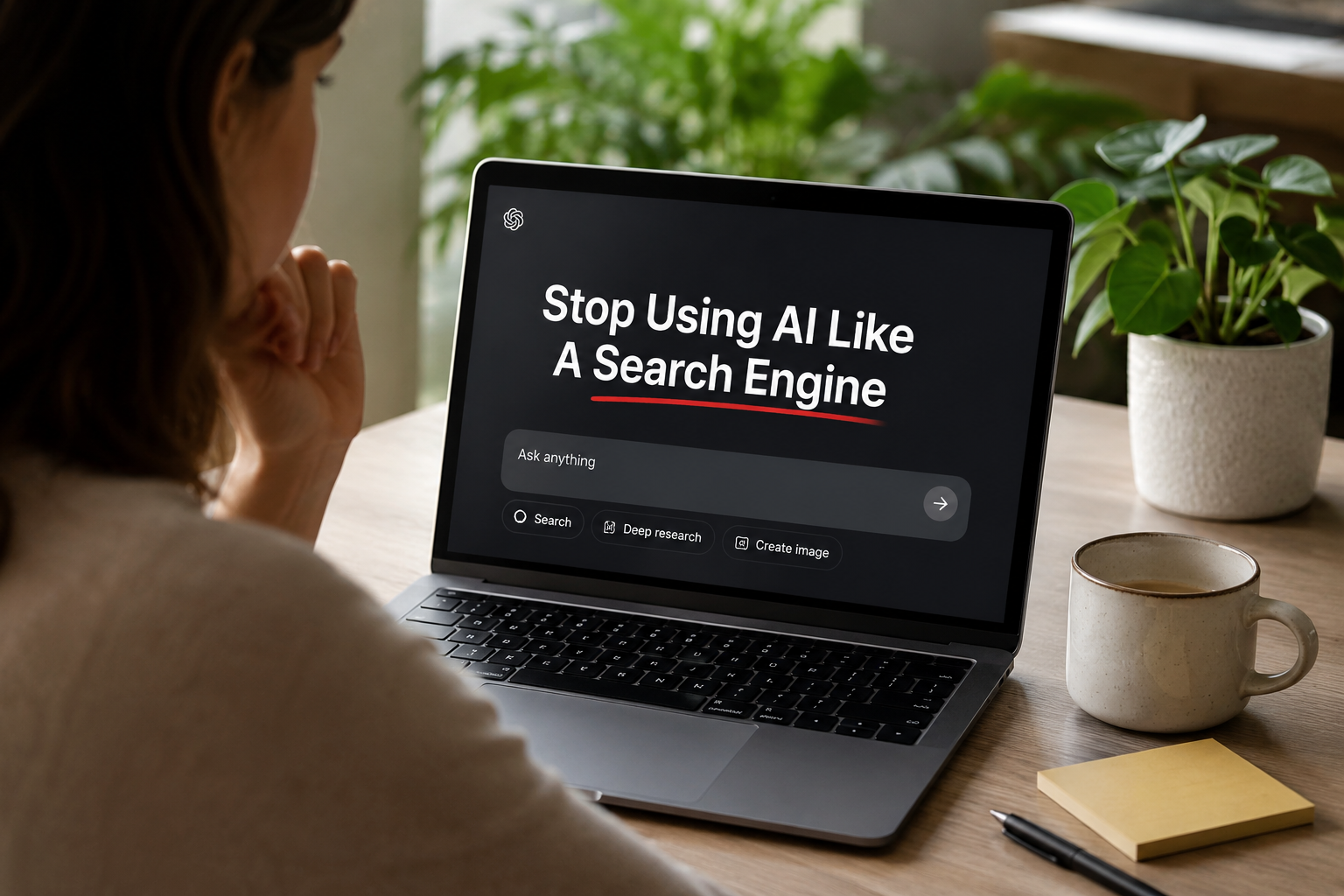
Maine teams get better AI results when they stop treating ChatGPT and Copilot like search boxes and start using them as workflow partners with context, examples, constraints, and verification.
Many organizations begin with AI by asking a question the same way they would type into Google. That can be useful for quick brainstorming, but it is also the reason many early pilots feel disappointing. A search engine is designed to retrieve and rank sources. A generative AI system is designed to produce a response based on patterns, context, and instructions. OpenAI's prompting guidance emphasizes giving clear instructions, context, examples, and desired output formats rather than relying on vague one-line requests (OpenAI prompting fundamentals).
The difference matters for Maine businesses because staff do not need another novelty tool. They need a safer way to draft donor emails, summarize meetings, prepare grant language, compare vendor proposals, outline policies, and turn messy notes into usable documents. Those tasks require background information. They require the user to explain the audience, goal, constraints, tone, source material, and what should not be included.
A better mental model is this: AI is not the answer machine. It is a draft-and-reasoning partner that still needs a responsible human editor. OpenAI warns that ChatGPT can produce fake citations or inaccurate information and recommends using it as a first draft rather than a final source (OpenAI Help Center guidance on fake citations). That is especially important for public agencies, nonprofits, regulated businesses, and professional services firms where a confident wrong answer can damage trust.
- Do not use AI as a replacement for source checking.
- Give the model context, examples, constraints, and a clear output format.
- Use AI for drafting, summarizing, comparison, training, and decision support.
- Create staff rules for what information can and cannot be pasted into tools.
- Measure whether AI improves a workflow, not whether people enjoyed trying it.
What good prompting looks like in a Maine workplace
A weak prompt says, "Write a grant email." A stronger prompt says, "You are helping a Maine nonprofit draft a warm but concise email to prior donors about a workforce training grant. Use the bullet points below, avoid making claims not in the notes, keep it under 350 words, and provide three subject lines." That second version gives role, context, audience, constraints, facts, and output format. It is not magic. It is clear delegation.
The same idea applies to municipal work. A town office might ask AI to summarize public comments, but the safer workflow is to provide the actual notes, require neutral language, ask for themes rather than decisions, and have a human review the output before it is used in a public meeting packet. NIST's AI Risk Management Framework is useful here because it frames AI risk around governance, mapping, measurement, and management rather than tool enthusiasm (NIST AI RMF).
Where AI works better than search
AI can help convert unstructured material into structured work products. It can turn a transcript into action items, compare two policy drafts, create role-based training examples, rewrite technical language for a public audience, and produce checklists from a procedure. These are not search tasks. They are transformation tasks. The input is your material, the output is a useful draft, and the value comes from the context you provide.
Research and survey data suggest organizations are moving from experimentation toward workflow redesign. McKinsey's 2025 State of AI research describes the gap between broad adoption and scaled value, with stronger results coming from organizations that redesign work and invest in adoption practices (McKinsey State of AI 2025). Microsoft makes a similar point in its Work Trend Index, describing a shift toward human-agent collaboration and more deliberate AI operating models (Microsoft Work Trend Index).
What this means for Maine businesses
For Maine employers, the practical question is not whether a national AI trend sounds impressive. The question is whether it changes a real workflow in a small business, town office, school, nonprofit, healthcare practice, construction firm, law office, hospitality group, or professional services team. Maine organizations often run lean. A single administrative bottleneck, missed follow-up, slow intake process, or inconsistent document workflow can matter more than a headline about frontier models. That is why AI adoption here should start with work mapping, staff training, privacy rules, and measurable use cases rather than broad experimentation.
For a Portland accounting firm, that may mean using AI to prepare first drafts of client explanation memos while prohibiting confidential tax details in public tools. For a construction company, it may mean summarizing project notes and change orders while requiring staff to verify numbers manually. For a nonprofit, it may mean creating a grant-draft workflow that separates brainstorming from final factual claims.
Action steps
- Pick one workflow where better drafting, summarizing, routing, or follow-up would save time without increasing risk.
- Write down what data is allowed, what data is restricted, and who approves new AI tools before staff begin experimenting.
- Train staff on prompting, verification, privacy, and escalation instead of assuming a tool rollout equals adoption.
- Measure results with simple operational metrics: time saved, errors reduced, response speed, customer satisfaction, and staff confidence.
- Review the workflow after 30 days and decide whether to scale, revise, or stop.
Risks and limitations
The biggest risk is not that staff use AI. The bigger risk is that they use it informally, inconsistently, and without knowing when it is wrong. Any training program should include examples of hallucinations, privacy rules, source verification, and escalation. AI output should be labeled as draft work unless it has been reviewed. The rule of thumb is simple: AI can accelerate a knowledgeable worker, but it should not quietly become the authority.
How to evaluate this locally
The safest way to evaluate ai education is to turn the trend into a local workflow question. A Maine organization should ask where the issue touches actual work: intake, scheduling, documentation, customer response, employee training, vendor selection, records management, grant writing, policy review, operations reporting, or leadership decision-making. This keeps the conversation grounded. Instead of asking whether AI is impressive, ask whether it can improve one defined process without weakening privacy, trust, accessibility, or accountability.
That evaluation should include people who understand the work, not only technology decision-makers. Front-desk staff, program managers, municipal clerks, department heads, finance staff, HR leaders, and customer-facing employees often know where work breaks down. They know which forms are confusing, which emails repeat, which reports take too long, which approvals stall, and which customers need a human voice. Their input helps separate useful automation from expensive theater.
What to measure
A practical pilot should measure results before it expands. Useful measures include time saved, number of drafts produced, error rates, customer response time, staff satisfaction, number of escalations, and whether sensitive information stayed inside approved systems. For public-sector or nonprofit settings, add transparency and documentation measures: who reviewed the output, whether sources were retained, and whether final decisions were made by accountable people.
Leaders should also measure friction. If a tool saves one hour of drafting but creates two hours of cleanup, it is not a productivity gain. If staff avoid it because the policy is unclear, the issue is training and governance. If the tool works only for one tech-comfortable employee, the organization has not yet built a repeatable process. The goal is not a flashy demonstration. The goal is a repeatable operating habit.
Governance questions before scaling
- What data can safely be used with this tool, and what data is prohibited?
- Who is accountable for reviewing outputs before they affect customers, residents, employees, or clients?
- What is the human fallback when the tool is wrong, confusing, biased, unavailable, or inappropriate?
- How will staff know whether a vendor changed model behavior, retention rules, or product terms?
- What records need to be preserved for compliance, public accountability, or internal learning?
A 90-day adoption path
In the first 30 days, select one low-risk workflow and document the current process. In days 31 to 60, train a small group of staff, run the workflow with human review, and collect simple before-and-after measures. In days 61 to 90, decide whether to keep, revise, or stop the pilot. If it works, write the process down so another staff member can repeat it. If it does not work, document why. A failed pilot with clear learning is much better than uncontrolled experimentation with no record.
For AI Impact Maine's clients, this kind of operating discipline is usually where value appears. The technology matters, but the durable advantage comes from clearer workflows, better staff confidence, stronger policies, and a habit of evaluating AI against real outcomes. That is how a Maine organization can respond to stop using ai like a search engine without being swept up by hype or frozen by uncertainty.
Sources & Further Reading: